
Quan Tâm Nhiều
-
 Here is a 20-question quiz about English verb tense. Can you got 20/20 correct answers? Prove your talent Now. 1. My friend _______ to t...
 -
 A prefix is placed at the beginning of a word to modify or change its meaning. This is a list of the most common prefixes in English...
 -
 So what does that mean when we’re talking about learning? Well, youneed to think about like your mind, your brain. So if you learn somethi...
 -
QUIZ ABOUT HAND IDIOMS 1. Learning a foreign language goes hand in hand with International Business. individually t...
-
 An exclamation (also called an interjection ) is a word or phrase that expresses strong emotion, such as surprise, pleasure, or anger. Exc...
 -
Quiz on idioms with KEEP 1. My only advice to Charlie was to keep his chin up and stop worrying. try to be optimistic ...
-
 A conjunction (also called a connective ) is a word such as and , because , but , for , if , or , and when . Conjunctions are used to conne...
 -
Listening is the key to fluency. Now why focus on listening first? Why learn with your ears and not with your eyes? With listening you wil...
-
 Bộ tài liệu luyện nghe English Tactics For Listening (Audio + ebook) với 3 cấp độ Basic, Developing & Extending do đại học Oxford phát...
Some Heartfelt Expressions
Each week, this program explains the many meanings of English expressions.
Today’s expressions include a very important word -- heart.
Now, let us suppose you and I were speaking freely about something private. We would be having a “heart-to-heart” discussion. I might speak “from the bottom of my heart,” or say things honestly and truthfully. I might even “open up my heart” to you and tell a secret. I would speak “with all my heart,” or with great feeling.
When a person shares her feelings freely and openly like this, you might say she “wears her heart on her sleeve,” or on her clothing. Her emotions are not protected.
If we had an honest discussion, both of us would know that the other person’s heart is “in the right place.” For example, I would know that you are a kind-hearted and well-meaning person. And, if you are a very good person, I would even say that you have “a heart of gold.” However, you might have “a change of heart” based on what I tell you -- our discussion might cause you to change the way you feel about something.
But, let us suppose you get angry over what I tell you. Or worse, you feel no sympathy or understanding for me or my situation. If this happens, I might think that you have “a heart of stone.” And, if you say something to make me frightened or worried, my heart might stand still or “skip a beat.”
Yet, even though you may be angry, I would know that at heart, you are a kind person. In reality, you do care. And any argument between us would not cause me to “lose heart,” or feel a sense of loss.
“My heart goes out” to anyone who loses a friend over an argument: it really is a sad situation, and I feel sympathy for the people involved.
I promise that what I have told you today is true – “cross my heart.:
I really wanted to play some music at the end of this feature. In fact, I had my “heart set on it.” So here it is: “Don’t Go Breaking my Heart” by Elton John.
Read more…
Today’s expressions include a very important word -- heart.
Now, let us suppose you and I were speaking freely about something private. We would be having a “heart-to-heart” discussion. I might speak “from the bottom of my heart,” or say things honestly and truthfully. I might even “open up my heart” to you and tell a secret. I would speak “with all my heart,” or with great feeling.
When a person shares her feelings freely and openly like this, you might say she “wears her heart on her sleeve,” or on her clothing. Her emotions are not protected.
If we had an honest discussion, both of us would know that the other person’s heart is “in the right place.” For example, I would know that you are a kind-hearted and well-meaning person. And, if you are a very good person, I would even say that you have “a heart of gold.” However, you might have “a change of heart” based on what I tell you -- our discussion might cause you to change the way you feel about something.
But, let us suppose you get angry over what I tell you. Or worse, you feel no sympathy or understanding for me or my situation. If this happens, I might think that you have “a heart of stone.” And, if you say something to make me frightened or worried, my heart might stand still or “skip a beat.”
Yet, even though you may be angry, I would know that at heart, you are a kind person. In reality, you do care. And any argument between us would not cause me to “lose heart,” or feel a sense of loss.
“My heart goes out” to anyone who loses a friend over an argument: it really is a sad situation, and I feel sympathy for the people involved.
I promise that what I have told you today is true – “cross my heart.:
I really wanted to play some music at the end of this feature. In fact, I had my “heart set on it.” So here it is: “Don’t Go Breaking my Heart” by Elton John.
From Couch Potato to Cabin Fever
Some unusual words describe how a person spends his or her time. For example, someone who likes to spend a lot of time sitting or lying down while watching television is sometimes called a couch potato. A couch is a piece of furniture that people sit on while watching television.
Robert Armstrong, an artist from California, developed the term couch potato in nineteen seventy-six. Several years later, he listed the term as a trademark with the United States government. Mister Armstrong also helped write a funny book about life as a full-time television watcher. It is called the “Official Couch Potato Handbook.”
Couch potatoes enjoy watching television just as mouse potatoes enjoy working on computers. A computer mouse is the device that moves the pointer, or cursor, on a computer screen. The description of mouse potato became popular in nineteen ninety-three. American writer Alice Kahn is said to have invented the term to describe young people who spend a lot of time using computers.
Too much time inside the house using a computer or watching television can cause someone to get cabin fever. A cabin is a simple house usually built far away from the city. People go to a cabin to relax and enjoy quiet time.
cabin fever is not really a disease. However, people can experience boredom and restlessness if they spend too much time inside their homes. This is especially true during the winter when it is too cold or snowy to do things outside. Often children get cabin fever if they cannot go outside to play. So do their parents. This happens when there is so much snow that schools and even offices and stores are closed.
Some people enjoy spending a lot of time in their homes to make them nice places to live. This is called nesting or cocooning. Birds build nests out of sticks to hold their eggs and baby birds. Some insects build cocoons around themselves for protection while they grow and change. Nests and cocoons provide security for wildlife. So people like the idea of nests and cocoons, too.
 The terms cocooning and nesting became popular more than twenty years ago. They describe people buying their first homes and filling them with many things. These people then had children.
 Now these children are grown and have left the nest. They are in college. Or they are married and starting families of their own far away. Now these parents are living alone without children in their empty nest. They have become empty nesters.
What’s a GI Joe?
A “leatherneck” or a “grunt” do not sound like nice names to call someone. Yet men and women who serve in the United States armed forces are proud of those names. And if you think they sound strange, consider “doughboy” and “GI Joe.”
After the American Civil War in the 1860s, a writer in a publication called Beadle’s Monthly used the word “doughboy” to describe Civil War soldiers. But word expert Charles Funk says that early writer could not explain where the name started.
About twenty years later, someone did explain. She was the wife of the famous American general George Custer. Elizabeth Custer wrote that a “doughboy” was a sweet food served to Navy men on ships. She also said the name was given to the large buttons on the clothes of soldiers. Elizabeth Custer believed the name changed over time to mean the soldiers themselves.
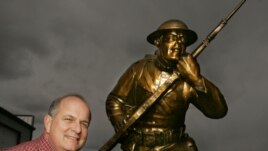 Now, we probably most often think of “doughboys” as the soldiers who fought for the Allies in World War I. By World War II, soldiers were called other names. The one most often heard was “GI,” or “GI Joe.” Most people say the letters GI were a short way to say “general issue” or “government issue.” The name came to mean several things: It could mean the soldier himself. It could mean things given to soldiers when they joined the military such as weapons, equipment or clothes. And, for some reason, it could mean to organize, or clean.
Soldiers often say, “We GI’d the place.” And when an area looks good, soldiers may say the area is “GI.” Strangely, though, “GI” can also mean poor work, a job badly done.
Some students of military words have another explanation of “GI.” They say that instead of “government issue” or “general issue,” “GI” came from the words “galvanized iron.” The American soldier was said to be like galvanized iron -- a material produced for special strength. The Dictionary of Soldier Talk says “GI” was used for the words “galvanized iron” in a publication about the vehicles of the early 20th century.
Today, a doughboy or GI may be called a “grunt.” Nobody is sure of the exact beginning of the word. But the best idea probably is that the name comes from the sound that troops make when ordered to march long distances carrying heavy equipment.
 A member of the United States Marines also has a strange name: “leatherneck.” It is thought to have started in the 1800s. Some say the name comes from the thick collars of leather early Marines wore around their necks to protect them from cuts during battles. Others say the sun burned the Marines’ necks until their skin looked like leather.
Read more…
After the American Civil War in the 1860s, a writer in a publication called Beadle’s Monthly used the word “doughboy” to describe Civil War soldiers. But word expert Charles Funk says that early writer could not explain where the name started.
About twenty years later, someone did explain. She was the wife of the famous American general George Custer. Elizabeth Custer wrote that a “doughboy” was a sweet food served to Navy men on ships. She also said the name was given to the large buttons on the clothes of soldiers. Elizabeth Custer believed the name changed over time to mean the soldiers themselves.
Soldiers often say, “We GI’d the place.” And when an area looks good, soldiers may say the area is “GI.” Strangely, though, “GI” can also mean poor work, a job badly done.
Some students of military words have another explanation of “GI.” They say that instead of “government issue” or “general issue,” “GI” came from the words “galvanized iron.” The American soldier was said to be like galvanized iron -- a material produced for special strength. The Dictionary of Soldier Talk says “GI” was used for the words “galvanized iron” in a publication about the vehicles of the early 20th century.
Today, a doughboy or GI may be called a “grunt.” Nobody is sure of the exact beginning of the word. But the best idea probably is that the name comes from the sound that troops make when ordered to march long distances carrying heavy equipment.
Buff: Are You a Buff About Something?
The word buff has several meanings. Buff is a light yellow color. Buff is also a soft cloth used to rub a surface until it looks bright and shiny.
Yet these meanings are old, and their history is not known. The meaning of buff that we do know about is one that describes a person. A buff is someone who has a strong, special interest in something. For example, someone who loves jazz music is a jazz buff. Someone who is deeply interested in the American Civil War is a Civil War buff.
This meaning of the word is known to be American. Its use started almost two-hundred years ago in New York City.
At that time, New York was a growing city. There were no huge tall buildings of steel and stone. Buildings then were made of wood and brick. Many were old and fires often broke out in them. The city did not have well-organized fire departments. So when the fire alarm bell rang, men near the sound of the fire bell dropped what they were doing and rushed out to fight the fire.
Later, fire companies were organized with men who were trained to fight fires. They were not paid to do this. They earned their money at other jobs, but dropped what they were doing when the fire bell rang.
In cold weather, many of these young volunteer firefighters wore coats made of the skin of buffalo to keep them warm and dry. Often, when the fire bell rang, other men in the city rushed to help put out the fire. They also wore coats of buffalo skin. In time, any man who rushed to fight a fire became known as a fire buff because of the buffalo coat he wore.
Time, however, has a way of bringing changes. Cities organized fire departments. Firemen became professionals. They are paid to do their job.
Yet, even today, we still have fire buffs who seem to appear at every fire in an area. Sometimes they prevent firemen from doing their jobs.
A leading New York newspaper published a story with the headline, "Fire Buffs Barred From Blaze." The story was about an order from New York's fire commissioner. He was angry. He told reporters that his firefighters were having trouble getting near the fire, because fire buffs who wanted to help were really getting in the way. So, he said, he did not want anyone but firefighters to go to a fire.
Fire buffs are still around, but the word has taken on a wider meaning. It includes all who have a deep interest in something or some activity. And so we can thank the American buffalo that once wandered the open plains for this meaning of the word buff.
"Hot" expressions
 Expressions about water are almost as common as water itself. But many of the expressions using water have unpleasant meanings.
 That no longer happens. But we still get in "hot water." When we are in "hot water," we are in trouble. It can be any kind of trouble--serious, or not so serious. A person who breaks a law can be in hot water with the police. A young boy can be in hot water with his mother, if he walks in the house with dirty shoes.
Being in "deep water" is almost the same as being in hot water. When you are in "deep water," you are in a difficult position. Imagine a person who cannot swim being thrown in water over his head.
You are in deep water when you are facing a problem that you do not have the ability to solve. You can be in deep water, for example, if you invest in stocks without knowing anything about the stock market.
"To keep your head above water" is a colorful expression that means staying out of debt. A company seeks to keep its head above water during economic hard times. A man who loses his job tries to keep his head above water until he finds a new job.
"Water over the dam" is another expression about a past event. It is something that is finished. It cannot be changed. The expression comes from the idea that water that has flowed over a dam cannot be brought back again.
When a friend is troubled by a mistake she has made, you might tell her to forget about it. You say it is water over the dam.
Another common expression, "to hold water," is about the strength or weakness of an idea or opinion that you may be arguing about. It probably comes from a way of testing the condition of a container. If it can hold water, it is strong and has no holes in it. If your argument can hold water, it is strong and does not have any holes. If it does not hold water, then it is weak and not worth debating.
"Throwing cold water" also is an expression that deals with ideas or proposals. It means to not like an idea. For example, you want to buy a new car because the old one has some problems. But your wife "throws cold water" on the idea, because she says a new car costs too much.
Expressions with the word "HAND"
The hand has been a symbol through the ages and in many cultures. There are hundreds of expressions and combinations of words using hand in the English language. Let us examine some of the expressions that use hand.
We will get a hand in this way. To get a hand in is to begin a job, to begin to know something about it. When we learn the job completely, it will be easy for us. We will be able to do it hands down.
On the other hand, if the situation gets out of hand, then it is out of control. We must act quickly to regain the upper hand over these expressions.
But, wait. We still do not have the upper hand in this business.
We must consider another way of expressing praise, to hand it to someone. For example: I must hand it to you for understanding what we have discussed this far.
You can also lend a hand to someone, but without really giving up your hand. You lend a hand when you help someone. You offer them a helping hand.
If someone is kind enough to lend us a hand, then we surely do not want to bite the hand that feeds us. We do not want to repay his kindness by treating him badly.
Now, with that out of the way, we have a free hand to continue examining other hand expressions. To have a free hand in a situation is good. It means you are free to act without getting permission from someone else.
If we continue moving along, we will make progress hand over fist, or very rapidly. This expression began in the early seventeen hundreds. It reportedly comes from a sailing expression hand over hand, the way of quickly raising or lowering a sail.
Maybe you can find a friend who wants to take a hand in our project. It would have to be someone who is interested in these expressions.
Your friend may want to work hand in glove with us. That is good, because that means he wants to work as closely with us as a glove covers the hand. Of course there is a danger that he may look at our project and decide to take it in hand. That means he wants to take it over.
If that happens, we may throw up our hands because the situation seems hopeless. In fact, we may decide that it is time for us to end this project, to wash our hands of hand expressions.
CLICK HERE TO DO A QUIZ ABOUT HAND IDIOMS
Color expressions
Every people has its own way of saying things, its own special expressions. Many everyday American expressions are based on colors.
Red is a hot color. Americans often use it to express heat. They may say they are red hot about something unfair. When they are red hot they are very angry about something. The small hot tasting peppers found in many Mexican foods are called red hots for their color and their fiery taste. Fast loud music is popular with many people. They may say the music is red hot, especially the kind called Dixieland jazz.
Pink is a lighter kind of red. People sometimes say they are in the pink when they are in good health. The expression was first used in America at the beginning of the twentieth century. It probably comes from the fact that many babies are born with a nice pink color that shows that they are in good health.
Blue is a cool color. The traditional blues music in the United States is the opposite of red hot music. Blues is slow, sad and soulful. Duke Ellington and his orchestra recorded a famous song – Mood Indigo – about the deep blue color, indigo. In the words of the song: “You ain’t been blue till you’ve had that Mood Indigo.” Someone who is blue is very sad.
The color green is natural for trees and grass. But it is an unnatural color for humans. A person who has a sick feeling stomach may say she feels a little green. A passenger on a boat who is feeling very sick from high waves may look very green.
Sometimes a person may be upset because he does not have something as nice as a friend has, like a fast new car. That person may say he is green with envy. Some people are green with envy because a friend has more dollars or greenbacks. Dollars are called greenbacks because that is the color of the back side of the paper money.
The color black is used often in expressions. People describe a day in which everything goes wrong as a black day. The date of a major tragedy is remembered as a black day. A blacklist is illegal now. But at one time, some businesses refused to employ people who were on a blacklist for belonging to unpopular organizations.
In some cases, colors describe a situation. A brown out is an expression for a reduction in electric power. Brown outs happen when there is too much demand for electricity. The electric system is unable to offer all the power needed in an area. Black outs were common during World War Two. Officials would order all lights in a city turned off to make it difficult for enemy planes to find a target in the dark of night.
Read more…
Red is a hot color. Americans often use it to express heat. They may say they are red hot about something unfair. When they are red hot they are very angry about something. The small hot tasting peppers found in many Mexican foods are called red hots for their color and their fiery taste. Fast loud music is popular with many people. They may say the music is red hot, especially the kind called Dixieland jazz.
Pink is a lighter kind of red. People sometimes say they are in the pink when they are in good health. The expression was first used in America at the beginning of the twentieth century. It probably comes from the fact that many babies are born with a nice pink color that shows that they are in good health.
Blue is a cool color. The traditional blues music in the United States is the opposite of red hot music. Blues is slow, sad and soulful. Duke Ellington and his orchestra recorded a famous song – Mood Indigo – about the deep blue color, indigo. In the words of the song: “You ain’t been blue till you’ve had that Mood Indigo.” Someone who is blue is very sad.
The color green is natural for trees and grass. But it is an unnatural color for humans. A person who has a sick feeling stomach may say she feels a little green. A passenger on a boat who is feeling very sick from high waves may look very green.
Sometimes a person may be upset because he does not have something as nice as a friend has, like a fast new car. That person may say he is green with envy. Some people are green with envy because a friend has more dollars or greenbacks. Dollars are called greenbacks because that is the color of the back side of the paper money.
The color black is used often in expressions. People describe a day in which everything goes wrong as a black day. The date of a major tragedy is remembered as a black day. A blacklist is illegal now. But at one time, some businesses refused to employ people who were on a blacklist for belonging to unpopular organizations.
In some cases, colors describe a situation. A brown out is an expression for a reduction in electric power. Brown outs happen when there is too much demand for electricity. The electric system is unable to offer all the power needed in an area. Black outs were common during World War Two. Officials would order all lights in a city turned off to make it difficult for enemy planes to find a target in the dark of night. Words About Clothing
Have you ever considered all the English expressions that include words about clothes? Let’s see if I can name a few off the cuff, or without any preparation.
People wear pants to cover the lower part of their bodies. We sometimes say that people who are restless or nervous have ants in their pants. They might also fly by the seat of their pants. They use their natural sense to do something instead of their learned knowledge. Sometimes, people may get caught with their pants down. They are found doing something they should not be doing. And, in every family, one person takes control. Sometimes a wife tells her husband what to do. Then we say she wears the pants in the family.
Pants usually have pockets to hold things. Money that is likely to be spent quickly can burn a hole in your pocket. Sometimes you need a belt to hold up your pants. If you have less money than usual, you may have to tighten your belt. You may have to live on less money and spend your money carefully. But once you have succeeded in budgeting your money, you will have that skill under your belt.
I always praise people who can save their money and not spend too much. I really take my hat off to them. Yet, when it comes to my own money, I spend it at the drop of a hat – immediately, without waiting. And sadly, you cannot pull money out of a hat. You cannot get money by inventing or imagining it.
Boots are a heavy or strong kind of shoes. People who are too big for their boots think they are more important than they really are. I dislike such people. I really do. You can bet your boots on that. Yet, truly important people are hard to replace. Rarely can you fill their shoes or replace them with someone equally effective.
My father is an important person. He runs a big company. He wears a suit and tie and a shirt with sleeves that cover his arms. Some people who do not know him well think he is too firm and severe. They think he is a real stuffed shirt. But I know that my father wears his heart on his sleeve. He shows his feelings openly. And, he knows how to keep his shirt on. He stays calm and never gets angry or too excited.
Also, my father has never lost his shirt in a business deal. He is too smart to lose all or most of his money. This is because my father rolls up his sleeves and prepares to work hard. He often has a special plan or answer to a problem that he can use if he needs it. He is like a person who does magic tricks. We say he has a card up his sleeve.
Read more…
People wear pants to cover the lower part of their bodies. We sometimes say that people who are restless or nervous have ants in their pants. They might also fly by the seat of their pants. They use their natural sense to do something instead of their learned knowledge. Sometimes, people may get caught with their pants down. They are found doing something they should not be doing. And, in every family, one person takes control. Sometimes a wife tells her husband what to do. Then we say she wears the pants in the family.
Pants usually have pockets to hold things. Money that is likely to be spent quickly can burn a hole in your pocket. Sometimes you need a belt to hold up your pants. If you have less money than usual, you may have to tighten your belt. You may have to live on less money and spend your money carefully. But once you have succeeded in budgeting your money, you will have that skill under your belt.
I always praise people who can save their money and not spend too much. I really take my hat off to them. Yet, when it comes to my own money, I spend it at the drop of a hat – immediately, without waiting. And sadly, you cannot pull money out of a hat. You cannot get money by inventing or imagining it.
Boots are a heavy or strong kind of shoes. People who are too big for their boots think they are more important than they really are. I dislike such people. I really do. You can bet your boots on that. Yet, truly important people are hard to replace. Rarely can you fill their shoes or replace them with someone equally effective.
My father is an important person. He runs a big company. He wears a suit and tie and a shirt with sleeves that cover his arms. Some people who do not know him well think he is too firm and severe. They think he is a real stuffed shirt. But I know that my father wears his heart on his sleeve. He shows his feelings openly. And, he knows how to keep his shirt on. He stays calm and never gets angry or too excited.
Also, my father has never lost his shirt in a business deal. He is too smart to lose all or most of his money. This is because my father rolls up his sleeves and prepares to work hard. He often has a special plan or answer to a problem that he can use if he needs it. He is like a person who does magic tricks. We say he has a card up his sleeve. Chickenfeed: It Doesn't Add Up to Much
Almost every language in the world has a saying that a person can never be too rich.
Americans, like people in other countries, always want more money. One way they express this is by protesting that their jobs do not pay enough. A common expression is, "I am working for chickenfeed." It means working for very little money. The expression probably began because seeds fed to chickens made people think of small change. Small change means metal coins of not much value, like nickels which are worth five cents.
An early use of the word chickenfeed appeared in an American publication in nineteen thirty. It told about a rich man and his son. Word expert Mitford Mathews says it read, "I'll bet neither the kid nor his father ever saw a nickel or a dime. They would not have been interested in such chickenfeed."
Chickenfeed also has another interesting meaning known to history experts and World War Two spies and soldiers.
Spy expert Henry S. A. Becket writes that some German spies working in London during the war also worked for the British. The British government had to make the Germans believe their spies were working. So, British officials gave them mostly false information. It was called chickenfeed.
The same person who protests that he is working for chickenfeed may also say, "I am working for peanuts." She means she is working for a small amount of money.
It is a very different meaning from the main one in the dictionary. That meaning is small nuts that grow on a plant.
No one knows for sure how a word for something to eat also came to mean something very small. But, a peanut is a very small food.
The expression is an old one. Word expert Mitford Mathews says that as early as eighteen fifty-four, an American publication used the words peanut agitators. That meant political troublemakers who did not have a lot of support. Another reason for the saying about working for peanuts may be linked to elephants. Think of how elephants are paid for their work in the circus. They receive food, not money. One of the foods they like best is peanuts.
When you add the word gallery to the word peanut you have the name of an area in an American theater. A gallery is a high seating area or balcony above the main floor.
The peanut gallery got its name because it is the part of the theater most distant from where the show takes place. So, peanut gallery tickets usually cost less than other tickets. People pay a small amount of money for them.
Mouth expressions
People use their mouths for many things. They eat, talk, shout and sing. They smile and they kiss. In the English language, there are many expressions using the word mouth. But some of them are not so nice.
For example, if you say bad things about a person, the person might protest and say “Do not bad mouth me.”
Sometimes, people say something to a friend or family member that they later regret because hurts that person’s feelings. Or they tell the person something they were not supposed to tell.
The speaker might say: “I really put my foot in my mouth this time.” If this should happen, the speaker might feel down in the mouth. In other words, he might feel sad for saying the wrong thing.
Another situation is when someone falsely claims another person said something. The other person might protest: “I did not say that. Do not put words in my mouth.”
Information is often spread through word of mouth. This is general communication between people, like friends talking to each other. “How did you hear about that new movie?” someone might ask. “Oh, by word of mouth.” A more official way of getting information is through a company or government mouthpiece. This is an official spokesperson. Government-run media could also be called a mouthpiece.
Sometimes when one person is speaking, he says the same thing that his friend was going to say. When this happens, the friend might say: “You took the words right out of my mouth!” Sometimes a person has a bad or unpleasant experience with another person. He might say that experience “left a bad taste in my mouth.” Or the person might have had a very frightening experience, like being chased by an angry dog. He might say: “I had my heart in my mouth.”
Some people have lots of money because they were born into a very rich family. There is an expression for this, too. You might say such a person, “was born with a silver spoon in his mouth.”
This rich person is the opposite of a person who lives from hand to mouth. This person is very poor and only has enough money for the most important things in life, like food.
Parents might sometimes withhold sweet food from a child as a form of punishment for saying bad things. For example, if a child says things she should not say to her parents, she might be described as a mouthy child. The parents might even tell the child to stop mouthing off.
But enough of all this talk. I have been running my mouth long enough.
Insect expressions
There are many American expressions about insects -- like bees, for example. Bees are known as very hard workers. They always appear to be busy, moving around their homes, or hives. So you might say you were as busy as a bee if you spent your weekend cleaning your house. In fact, you might say your house was a beehive of activity if your whole family was helping you clean. You also might say you made a beeline for something if you went there right away. When we go to see a movie, my friend always makes a beeline for the place where they sell popcorn.
Here is an expression about bees that is not used much any more, but we like it anyway. We think it was first used in the nineteen twenties. If something was the best of its kind, you might say it was the bee's knees. Now, we admit that we do not know how this expression developed. If fact, we do not even know if bees have knees!
If your friend cannot stop talking about something because she thinks it is important, you might say she has a bee in her bonnet. If someone asks you a personal question, you might say "that is none of your beeswax." This means none of your business.
Speaking of personal questions, there is an expression people sometimes use when their children ask, "where do babies come from?" Parents who discuss sex and reproduction say this is talking about the birds and the bees.
(MUSIC)
Hornets are bee-like insects that sometimes attack people. It you are really angry, you might say you are mad as a hornet. And if you stir up a hornet's nest, you create trouble or problems. Butterflies are beautiful insects, but you would not want to have butterflies in your stomach. That means to be nervous about having to do something, like speaking in front of a crowd. You would also not want to have ants in your pants. That is, to be restless and unable to sit still.
Here are some expressions about plain old bugs, another word for insects. If a friend keeps asking you to do something you do not want to do, you might ask him to leave you alone or "stop bugging me." A friend also might tell you again and again to do something. If so, you might say he put a bug in your ear.
If you were reading a book in your warm bed on a cold winter's day, you might say you were snug as a bug in a rug. And, if you wish someone good night, you might say, "sleep tight -- don't let the bed bugs bite."
Hot expressions
“Hot” is a simple, easily understood word. So are most of the expressions made with the word hot -- but not always, as we shall see...


Read more…
The words hot potato, for example, give you no idea at all to the meaning of the expression “hot potato.”
The potato is a popular vegetable in the United States. Many people like baked potatoes, cooked in an oven or fire. Imagine trying to carry a hot, baked potato in your hand. It would be difficult -- even painful -- to do so. Now we are getting close to the meaning of “hot potato.”
Some publicly-disputed issues are highly emotional. The issues must be treated carefully, or they will be difficult and painful if an elected official has to deal with them -- as difficult and painful as holding a hot potato.
One such hot potato is taxes...
Calling for higher taxes can mean defeat for a politician. And yet, if taxes are not raised, some very popular government programs could be cut. And that
also can make a politician very unpopular. So the questions must be dealt with carefully -- the same way you would handle any other hot potato.
Another expression is “not so hot.” If you ask someone how she feels, she may answer “not so hot.” What she means is she does not feel well.
“Not so hot” also is a way of saying that you do not really like something. You may tell a friend that the new play you saw last night is “not so hot.” That means you did not consider it a success.
A “hot shot” is a person -- often a young person -- who thinks he can do anything. At least he wants to try. He is very sure he can succeed. But often he fails. The expression was born in the military forces. A “hot shot” was a soldier who fired without aiming carefully.
Hot is a word that is often used to talk about anger.
A person who becomes angry easily is called a “hothead.” An angry person's neck often becomes red. We say he is “hot under the collar.” You could say that your friend “is no hothead.” But he got “hot under the collar” when someone took his radio.
In 1963, “hotline” appeared as a new expression.
The hotline was a direct communications link between the leaders of the Soviet Union and the United States. The hotline had an important purpose: to prevent accidental war between the two competitors during the period known as the Cold War. The American president and the Soviet leader were able to communicate directly and immediately on the hotline. This helped prevent any conflict during an international crisis.
Fish Expressions: This All Sounds Very Fishy
Americans use many expressions about fish and fishing. For example, if something sounds fishy, it may not be true. Sometimes I feel like a fish out of waterwhen I go to a party and everyone but me is doing the latest dance. When I ask my friend if she likes my new dress, I would like her to say something nice. In other words, I am fishing for a compliment. You might tell someone to fish or cut bait if he repeatedly attempts to do something he is unable to do.
Sometimes a lawyer will ask a witness many questions in an effort to discover the facts of a court case. This is called going on a fishing expedition.
Some expressions involve different kinds of fish. Information that is used to draw attention away from the real facts of a situation is called a red herring. If you want to express a feeling of surprise, you might cry "holy mackerel!" although we do not know why a mackerel is holy.
Once I went to a county fair and tried my luck with a game of chance. It was so easy; it was like shooting fish in a barrel. Then I went on the fastest, highest and most frightening ride: the roller coaster. At the end of the ride, I did not feel so well. A friend said I looked green around the gills.
I grew up in a small town where everybody knew about my life. There were times when I thought I was living in a fishbowl. So I moved to Washington, where things were different.
Now I take the train to work every day during rush hour when many other people travel to their jobs. Sometimes the train is so crowded that we are packed in like sardines. Sardines are tiny fish that lie close to each other in cans. One man who works in my office is a cold fish. He is unfriendly and does not like to join us at office parties. Another man in my office likes to enjoy alcoholic drinks at parties. In fact, you might say he drinks like a fish. We need to help him stop drinking.
Last week, my sister's car broke down as we were driving to a friend's marriage ceremony. "This is a fine kettle of fish," I said. "Now we will be late."
My sister attends a small college where she is one of the smartest students. She always wants to be a big fish in a small pond. Recently, my sister broke up with her boyfriend. I told her not to worry, she will find another one because there are plenty of other fish in the sea.
Face Expressions
The first is face the music. It means to accept the results of what you have done.
Read more…
Here is an example from a Reuters news report: Britain’s highest court had ruled that former Chilean dictator Augusto Pinochet was legally arrested. Opponents of General Pinochet welcomed the news. One of them said, “We have waited for years for this man to face the music.”
No one is sure how the expression began. One story is that it came from a military ceremony held when a soldier was forced out of an army.
The buttons were cut from the soldier’s clothing. He was put on a horse, facing the back of the horse and led away. As he left, he faced the music of a military band and the soldiers he had served with.
Another story says the expression began in the theater. New actors, shaking with fright, were told that the only cure was to go out and face the music. The music was played by the orchestra seated in front of the stage.
A similar expression is face up to. It means to accept something that is difficult or painful. For example, a man must face up to the fact that he lied about a business deal and will lose his job. Or, a child must learn to face up to her responsibilities and complete her schoolwork.
Meeting someone face-to-face can be exciting, especially if the other person is famous. It is an expression one might use after visiting the White House and meeting the president face-to-face. Or a teacher might ask for a face-to-face meeting with the parents of a student in trouble. It means to talk to someone in person, not by telephone.
Another expression is as plain as the nose on your face. It means that something is as clear as it can possibly be.
Shakespeare used the words almost five hundred years ago for a joke in his play Two Gentlemen of Verona. Valentine secretly loves Lady Sylvia. His servant jokes that Valentine’s love for her is as hard to see as the nose on a man’s face. Of course, a man’s nose cannot be hidden. A more recent use of the expression appeared in a report in Newsday magazine. It was about a dispute between the United States and Europe over agriculture. The United States had criticized Europeans for protecting their soybean farmers. The Organization for Economic Cooperation and Development in return criticized the United States for its huge budget deficits. The report said the OECD seemed to be saying, “For God’s sake, it is plain as the nose on your face that you must raise taxes.”
Expressions with the word "NOSE"
A person’s nose is important for breathing and smelling. The nose is also used in many popular expressions.
Some people are able to lead other people by the nose. For example, if a wife leads her husband by the nose, she makes him do whatever she wants him to do.
Some people are said to be hard-nosed. They will not change their opinions or positions on anything. If someone is hard-nosed, chances are he will never pay through the nose, or pay too much money, for an object or service.
It is always helpful when people keep their nose out of other people’s business. They do not interfere. The opposite of this is someone who noses around all the time. This kind of person is interested in other people’s private matters. He is considered nosey.
Someone who keeps his nose to the grindstone works very hard. This can help a worker keep his nose clean or stay out of trouble.One unusual expression is that is no skin off my nose. This means that a situation does not affect or concern me. We also say that sometimes a person cuts off his nose to spite his face. That is, he makes a situation worse for himself by doing something foolish because he is angry.
More problems can develop if a person looks down his nose at someone or something. The person acts like something is unimportant or worthless. This person might also turn up his nose at something that he considers not good enough. This person thinks he is better than everyone else. He has his nose in the air.
In school, some students thumb their nose at their teacher. They refuse to obey orders or do any work. Maybe these students do not know the correct answers. My mother always told me, if you study hard, the answers should be right under your nose or easily seen.
I think we have explained the nose expressions. What about ears? Well, I hope you are all ears or very interested in hearing more expressions. We might even put a bug in your ear or give you an idea about something. We also advise you to keep your ear to the ground. This means to be interested in what is happening around you and what people are thinking.
If you are a good person, you will lend an ear to your friends. You will listen to them when they have a problem they need to talk about. Our last expression is to play it by ear. This has two meanings. One is to play a song on a musical instrument by remembering the tune and not by reading the music. Play it by ear also means to decide what to do at the last minute instead of making detailed plans.
Computer Terms: Good Hackers, Bad Hackers and Busy Bloggers
Computer technology has become a major part of people's lives. This technology has its own special words. One example is the word mouse. A computer mouse is not a small animal that lives in buildings and open fields. It is a small device that you move around on a flat surface in front of a computer. The mouse moves the pointer, or cursor, on the computer screen.
Computer expert Douglas Engelbart developed the idea for the mouse in the early nineteen-sixties. The first computer mouse was a carved block of wood with two metal wheels. It was called a mouse because it had a tail at one end. The tail was the wire that connected it to the computer.
Using a computer takes some training. People who are experts are sometimes called hackers. A hacker is usually a person who writes software programs in a special computer language. But the word hacker is also used to describe a person who tries to steal information from computer systems.
Another well known computer word is Google, spelled g-o-o-g-l-e. It is the name of a popular "search engine" for the Internet. People use the search engine to find information about almost any subject on the Internet. The people who started the company named it Google because in mathematics, googol, spelled g-o-o-g-o-l, is an extremely large number. It is the number one followed by one-hundred zeros.
When you "Google" a subject, you can get a large amount of information about it. Some people like to Google their friends or themselves to see how many times their name appears on the Internet.
If you Google someone, you might find that person's name on a blog. A blog is the shortened name for a Web log. A blog is a personal Web page. It may contain stories, comments, pictures and links to other Web sites. Some people add information to their blogs every day. People who have blogs are called bloggers.Blogs are not the same as spam. Spam is unwanted sales messages sent to your electronic mailbox. The name is based on a funny joke many years ago on a British television show, "Monty Python's Flying Circus." Some friends are at an eating place that only serves a processed meat product from the United States called SPAM. Every time the friends try to speak, another group of people starts singing the word SPAM very loudly. This interferes with the friends' discussion – just as unwanted sales messages interfere with communication over the Internet.
Medical Terms
Many professions have their own words and expressions. This is true for the medical profession. Doctors use many technical terms that most people do not understand. But there are also expressions we use every day to tell about a person’s health. Let me explain.
Last month, I was not feeling well. I was under the weather. I thought I had caught a cold. I had a runny nose, itchy eyes, a sore throat and a cough. I felt tired and run down. I was in poor condition because I had not been getting enough rest.
My body hurt all over. I also had severe head pains -- a real splitting headache. And I was running a fever. My body temperature was higher than normal.
At one point, I blacked out. That’s right, I was out cold. I lost consciousness and my friend had to bring me around. He used cold water on my face to restore my consciousness.
I grew concerned that I might take a turn for the worse. I did not want to become sicker because then surely I would be at death’s door.
My friend took me to the doctor. I told the doctor I thought I had come down with a cold. When the doctor saw me, she immediately wanted to run some tests. She said that medical tests would help her discover why I was sick. The doctor also asked when I had my last physical. I do not get yearly check-ups. But I probably should get a medical exam by a doctor every year.
Then the nurse drew my blood. She used a needle to take a small amount of blood from my arm. She sent it to a laboratory for tests. The nurse also took my temperature. She used a thermometer to measure my body temperature.
The doctor told me I had influenza, or the flu. But she told me I would recover soon. She said I was over the worst of the disease. She told me to rest at home and to stay away from other people because the flu can spread. It is contagious.Thankfully, I did not have to go under the knife. I did not need an operation. Instead, I did just what the doctor ordered. I went home and did exactly what was needed to become healthy again. Soon, I was on the mend. I was pulling through and recovering from my sickness.
Now, I am back on my feet. I am physically healthy again. Even better, the doctor has given me a clean bill of health. She says that I am one-hundred percent cured. I am back to normal and I feel great. In fact, I feel on top of the world. My friends say I now look like the picture of health.
Top Hot

